250 Years of US and 100 Years of Black History Month
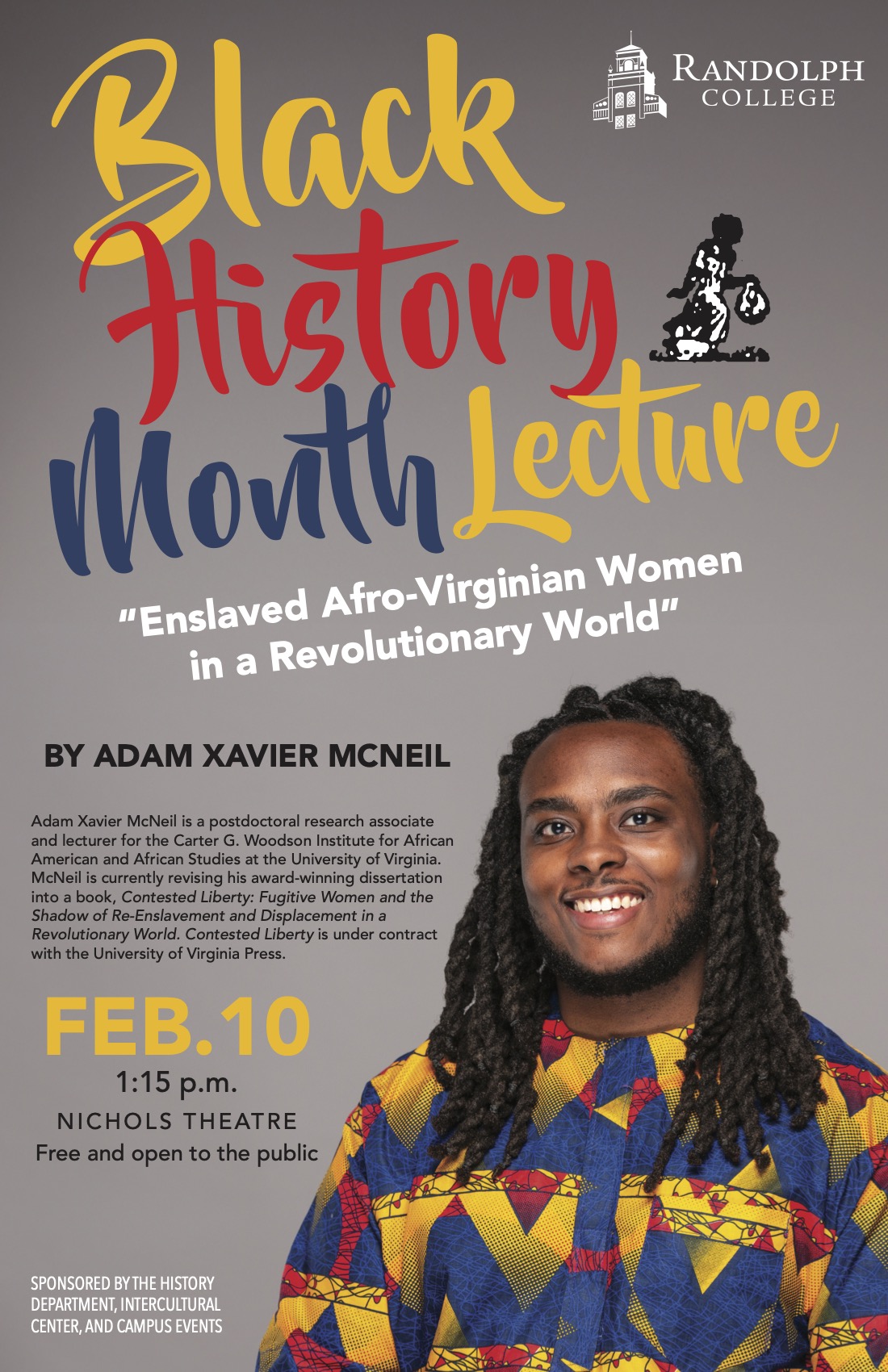
10 Feb 2026As part of my African American history class, I invited Dr. Adam McNeil to give a public lecture on his work about enslaved Afro-Virginian women during the Revolutionary War. It was a wonderful lecture and an honor to host him at Randolph. Special thanks to support from Randolph’s Campus Events Committee and the Intercultural Center for supporting the event.Here’s my introduction to Dr. McNeil’s talk:
_One hundred years ago – to the day – Americans were in the midst of celebrating the very first Black History Month, or as it was known then, “Negro History Week.” Designed by historian Dr. Carter G. Woodson, Negro History Week was created to help remedy the systematic erasure of Black Americans from American history. Dr. Woodson did not envision Negro History Week as the only time people should learn about Black history. Instead, he imagined it as an opportunity for schools to demonstrate what students had learned all year–it was a call for intentional remembering.
As Woodson envisioned it, Negro History Week was not an exercise in memorization or a box to be checked. He understood that how we remember the past has profound implications for the present. After all, 1926 was the height of Jim Crow segregation. Membership in the Ku Klux Klan was at an all-time high. Lynchings remained prevalent. Nativist and anti-immigrant rhetoric saturated public discourse. In Virginia, the General Assembly was passing racial integrity laws that banned interracial marriage, enforced the so-called “one-drop rule,” and mandated segregation in public spaces.
Dr. Woodson knew what he was doing when he created Negro History Week. He believed that knowing the truth could tear down the walls of segregation, hatred, racism, and white supremacy. “There would be no lynching if it did not start in the schoolroom,” Woodson declared.
Fifty years later, in 1976, Negro History Week evolved into Black History Month. And of course, 1976 was also the bicentennial, the year that Americans celebrated the 200th anniversary of the Declaration of Independence. So at precisely the moment Americans were asking themselves, “What is America? Who is American? And what does “liberty and justice for all” really mean?” At that moment, Woodson’s intellectual descendants were pushing to recommit the nation to remembering Black history.
This collision – of both the intentional remembering of Black history and the nation – is here with us today, too. 2026 is, after all, the 250th anniversary of the Declaration. And we are once again living in a time when the history of the Revolution and the founding era is being debated. Just weeks ago in Philadelphia, the National Park Service removed signage addressing the history of enslaved people held at the President’s House where George Washington lived while serving as the first President of the United States. History is never just about the past.
And so, in this 250th anniversary year of the Declaration of Independence and the 100th anniversary year of Black History Month, we have not just the opportunity but a duty to examine the experiences of Black Americans during the American Revolution. That is what makes today’s conversation so timely—and why I’m so excited to welcome our speaker today, a leading young scholar of African American history and the Revolution.
Adam Xavier McNeil is a Postdoctoral Research Associate and Lecturer in the Carter G. Woodson Institute for African American and African Studies at the University of Virginia. Dr. McNeil is currently revising his award-winning dissertation into a book, Contested Liberty: Fugitive Women and the Shadow of Re-Enslavement and Displacement in a Revolutionary World. Contested Liberty is under contract with the University of Virginia Press.
Please join me in giving a Wildcat Welcome to Dr. Adam McNeil._