02 Apr 2026
My peer-reviewed article in Religion and American Culture: A Journal of Interpretation is out!
“Coloring Sound: Religion, Race, and Music in Radio’s Network Era” focuses on the 1930s and 1940s, when radio was at the height of its national influence – think FDR’s Fireside Chats, Orson Welles’ War of the Worlds, or the rise of crooners.
It was exceedingly difficult for racial and religious outsiders to make themselves heard on this powerful new medium. For instance, on national networks like NBC and CBS, which dominated the industry, listeners were far more likely to hear white comedians pretending to be Black (as on the hit program Amos ‘n’ Andy) than to hear Black performers themselves.
There were, however, crucial exceptions. My article reveals how Black Protestants and white Latter-day Saints used sacred music as a wedge to break into exclusive network programming lineups. Though largely sidelined by scholars, broadcasting’s so-called Sunday morning “religious ghetto” became home to network radio’s largest concentration of nonwhite performers prior to the 1950s.
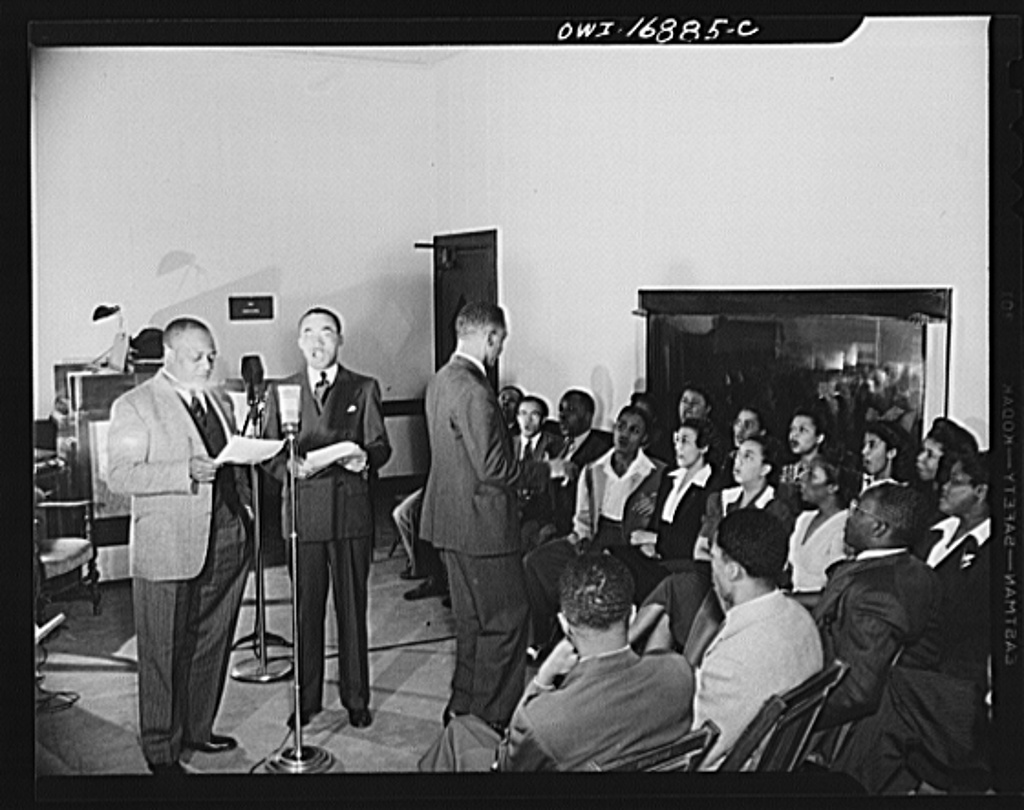
To get on the air and to stay there, groups like the Mormon Tabernacle Choir and Wings over Jordan (pictured below) had to skillfully navigate the demands of white industry executives and multiracial audiences. The result was a set of flawed yet beloved programs that both challenged and reinforced the assumed whiteness of network radio and of the nation it purported to reflect.
We often think about race and religion as something we “see.” This article suggests that these exceptional programs shaped how Americans learned to “hear” them.
Ultimately, it’s a story about the promise and peril of cultural representation for underrepresented groups.
–
For my non-academic friends: this is a big deal! Academic publishing is slow and rigorous. Articles go through layers of peer review to ensure the article is quality. Because the anonymous reviewers are overworked professors, this process can take a while. For reference, I submitted the article before P was born, and she’s almost two. And that doesn’t even count the fact that I first started thinking about this article about eight years ago while working on my dissertation proposal. I’m hoping it’s like a good crockpot meal: very slow but worth the wait!
Finally, I wrote this primarily for other professional historians but hope to write a more public-oriented version in the future. So no pressure to read the whole thing!
-
Image below: Gordon Parks, Orlando, Florida. Wings over Jordan, a popular Sunday morning radio program broadcast by Columbia Broadcasting System from station WDBO. President James A. Colston of Bethune-Cookman college speaking to a nationwide audience, February 1943. Courtesy of Library of Congress Prints and Photographs Division, https://www.loc.gov/resource/fsa.8d13672.
08 Apr 2022
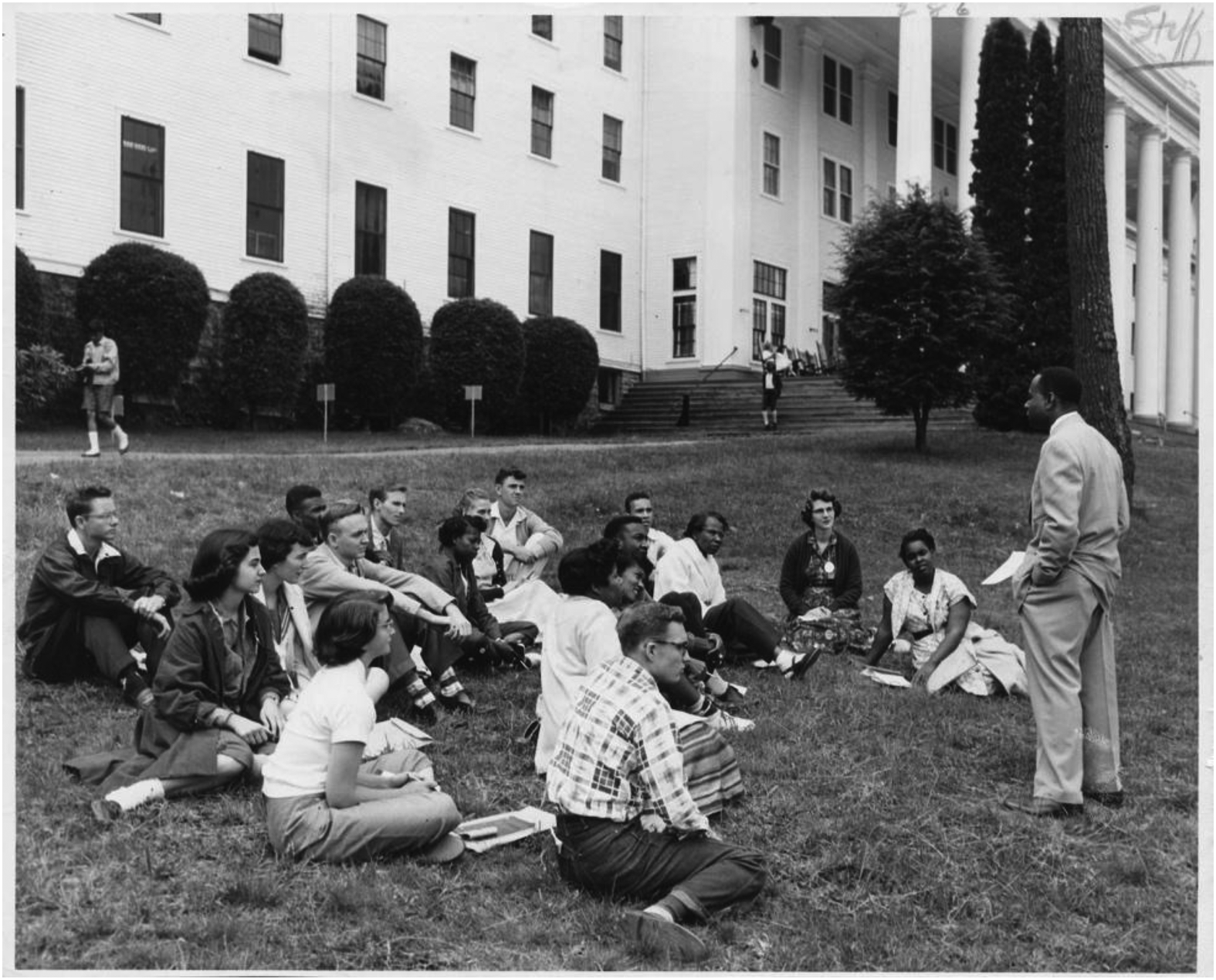
My article, “Step by Step: American Interracialism and the Origins of Talk-First Activism” has just been published in Modern American History!
Why are diversity trainings, dialogues, & social justice book clubs often proposed as first steps to creating an equitable society? “Step by Step” suggests that the answer lies in the history of an idea I call “talk-first activism.”
TLDR; in the first half of 20th century, a nationwide movement tries to fight prejudice by facilitating talk across the color line. In the 1940s-1950s, Black staffers in predominantly white Protestant organizations transform that movement through their insistence that talk must lead to action. Cue unintended consequences…
Because “Step by Step” was published by Modern American History as an open access article, you can read the article without a paid subscription! I’d be happy to discuss Step by Step with your classroom or organization.
Thanks to Sarah Phillips and the MAH team for their excellent editorial assistance, as well as to the anonymous reviewers for their helpful critiques. Special thanks to Monica Blair, Allison Kelley, Gillet Rosenblith, and, most of all, Grace Hale for their generous and insightful feedback. And shoutout to the Smith College Library, the University of Minnesota Library, and the University of Virginia’s department of history for their generous financial support of this project!
17 Jun 2021
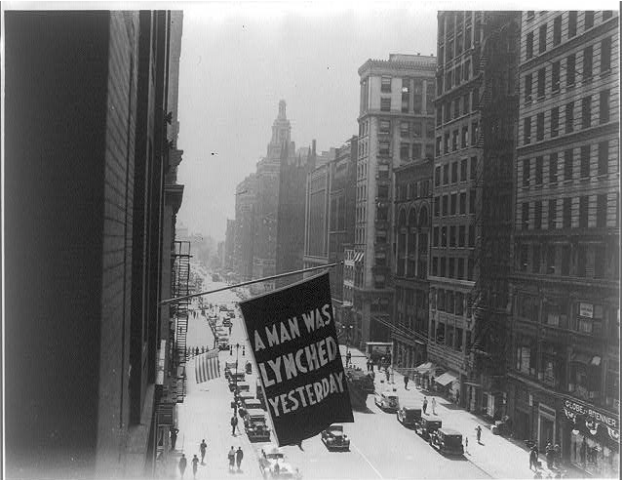
I use images all the time in class. But what about images that could cause harm? Check out my new Hybrid Pedagogy article, “With Care and Context” where I reflect on viewing lynching photographs as an undergraduate and how my thinking about the merits of teaching with such images has evolved over time.
I close my article with a few specific takeaways that I want to include here:
- Ask yourself if showing the potentially harmful image is truly necessary. Does presenting such images prioritize the learning experiences of white students over their classmates of color? Are there ways you can convey similar ideas without showing the image?
- Reflect on how these images fit with the rest of your course. Are most of your discussions of marginalized groups focused on pain and trauma? If so, consider how you might emphasize narratives or images of resistance, resilience, or joy.
- Provide students a chance to opt-out of the in-class viewing. Better yet, due to classroom power dynamics, try framing this as an “opt-in” rather than an “opt-out” experience. Try listing that day as “optional” on the syllabus or consider scheduling a time outside of your regular class session.
- Prepare your students beforehand. Provide ample context for what students will be seeing before presenting the images. Again, this context can frame how your students experience these images and help undermine their dehumanizing potential.
- Clearly state and contextualize the dehumanizing work that the image is doing. Remind students of the personhood of those being represented in the image.
- Maintain a posture of care. Share about your experience viewing the image and acknowledge that the experience of viewing the image will be different for different people. Though it can be harder in larger classes, be sure to check-in with your students before, during, and after the experience. Consider using small groups or “free writes” to provide students a more intimate space to process what they are learning.
- Keep working at it. Giving careful consideration to the images you use in class takes time and persistence, but it’s worth it!
Check out the rest of the article and let me know what you think!
I want to say a big thank you to all the people at Hybrid Pedagogy who made the article better, especially Managing Editor Bethany Thomas and reviewers Brandon Morgan and Daniel Lynds. Thanks for making my first time with a “double-open peer review” process a great one! I also want to say thanks to my wonderful friends and colleagues here at UVA who gave me helpful feedback early on in the process: Gillet Rosenblith, Monica Blair, Allison Kelley, and Grace Hale. And finally, a special shoutout for the Scholars’ Lab and especially Brandon Walsh for pointing me toward Hybrid Pedagogy and digital pedagogy in general!
10 May 2021
Land and Legacy, a digital project I co-created, was recently reviewed in the May edition of Reviews in Digital Humanities.
In their review, Claire. A Tratnyek of Northeastern University made a number of astute observations about the project. I appreciated Tratnyek’s insights and generosity. Here’s a brief excerpt:
“In both form and content, Land and Legacy is an exemplar of collaborative research and the integration of digital and
traditional historical methods. As scholars and citizens across the United States continue to uncover and confront the
difficult histories of our localities, this kind of project can provide us with new vocabularies for interdisciplinary
thinking and integrated storytelling — without sacrificing rigor or eliding uncomfortable questions.”
Reading Tratnyek’s generous review reminded me of how thankful I was to have such incredible project collaborators: Janet S Dunkelbarger,
Natasha Roth-Rowland, Lauren Van Nest, and Chloe Down Wells. Working with such wonderful colleagues (and now friends!) definitely makes me want
to do more collaborative scholarship in the future. Tratnyek’s review also made me super appreciative of the Scholars’ Lab community at UVA,
my time with the Praxis Program, and all the incredible people at UVA and around town who helped us out along the way!
You can read more about the specific roles I played on this website’s Projects page.
Finally, I want to note how cool it felt to have Land and Legacy reviewed alongside other great digital projects like “Mapping Marronage,” “GeoNewsMiner,”
and “Visualizing Objects, Spaces, and Places.” If you’re not following Reviews in Digital Humanities, you should be!